








Why this matters for compliance teams
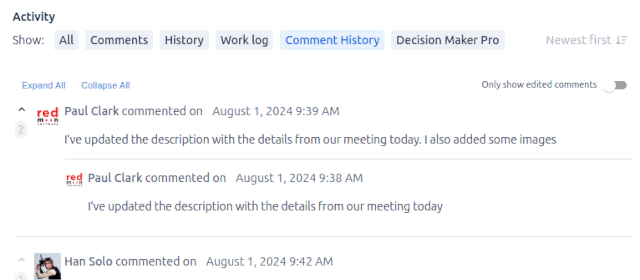
Information-handling policies generally start from a default-secure posture. Native Jira does the opposite: every new comment defaults to ‘All Users.’ On a sensitive project - audit, legal-hold, SOX, security - that default is wrong, and the only thing standing between confidential commentary and the wider audience is user memory.
For compliance teams, this is an unstable control. Training users to restrict every comment is unreliable. Auditors regularly flag the resulting leakage as a least-privilege gap. The control that matters is not ‘remind users’ but ‘change the default.’
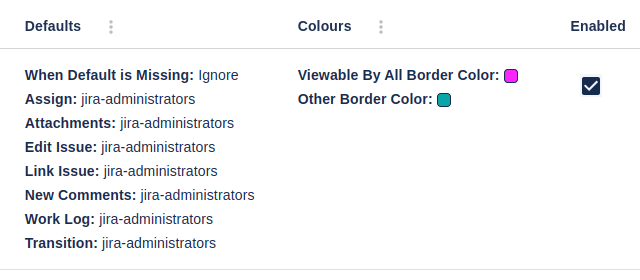
Comment Security Default supplies that control. The default comment visibility is set per project, to a role or group that matches the project’s information-handling policy. Every new comment inherits the default automatically. Broad visibility becomes an explicit choice, not a failure mode.
Where this fits in the compliance program
- Project setup - compliance-sensitive projects get a default-secure visibility policy at creation, mapping to the project’s information-handling tier.
- Daily operations - users continue to comment normally. The default applies; nobody needs to remember the policy on every comment.
- Audit evidence - the default-secure posture is a configuration-level control, not a user-behavior assumption. Auditors accept it as evidence.
What “good” looks like
Good is the compliance project where every internal comment is, by default, internal - because the policy is enforced at the configuration level, not at the user-memory level. Comment Security Default exists so compliance teams can have that control without training every user every quarter.
What compliance teams are dealing with today
- Jira's default comment visibility is 'All Users' - anyone with issue access sees every comment, regardless of project sensitivity.
- Compliance-sensitive projects (audit, security, legal-hold) routinely leak internal-only commentary because users forget to set the visibility on each comment.
- Information-handling policies require a default-secure posture; native Jira's default-open posture inverts the expectation.
- Auditors flagging 'failure to apply principle of least privilege' on Jira comments is a recurring finding.
- Training users to set comment visibility every time is unreliable - a default policy is the only durable control.
- Customer-portal projects can accidentally surface internal comments because the default visibility wasn't restricted at project level.
How Comment Security Default helps compliance teams
Per-project default visibility
Set a default comment visibility - internal group, project role, or specific user group - per project. Every new comment defaults to the project's policy, not Jira's global 'All Users.'
Policy-based information handling
Map compliance projects (audit, legal-hold, SOX, security) to internal-only defaults. New comments inherit the default automatically - no user training required.
Customer-portal protection
Service-desk and customer-portal projects can default internal comments to staff-only - eliminating the accidental exposure of internal triage notes to customers.
Reduced training burden
Users don't need to remember the policy on every comment. The default applies; deviations are explicit.
Audit-defensible posture
Comment Security Default makes the default-secure posture a system control rather than a user-behavior assumption - which is the kind of evidence auditors accept.
Use cases
- Audit project default to compliance-only. Internal-audit project defaults all comments to the audit role only. The compliance-sensitive commentary stays internal, even on tickets that include engineering as watchers.
- Service-desk internal notes. Customer-facing service-desk project defaults comments to 'service-desk team only.' Internal triage comments never leak to the customer portal.
- Legal-hold project lockdown. Litigation-hold project defaults comments to legal-team-only. No accidental customer- or engineering-visible comments on hold-relevant tickets.
- SOX change-management default. SOX-relevant change-management projects default approval comments to the change-advisory-board role - keeping the approval trail internal by default.
Common questions from compliance teams
Why is Jira's default 'All Users' a problem for compliance?
Default-open contradicts the principle of least privilege that most compliance frameworks expect. On a compliance-sensitive project - audit, legal-hold, SOX, security - the default should be 'staff only' or 'compliance role only,' with broad visibility as the explicit exception. Comment Security Default flips the polarity at the project level, so the default matches the project's information-handling policy.
Does the default apply to existing comments?
No - existing comments retain their existing visibility. Comment Security Default applies to new comments from the moment the policy is configured. For retroactive scope-tightening, use the Jira admin tools to bulk-update existing comments; the app is a forward-going default, not a retroactive cleanup tool.
Can users still override the default if they need broader visibility?
Yes. The default is exactly that - a default. Users can change the visibility on a per-comment basis when they need to. The point is that the safe choice is the default, and broad visibility becomes an explicit, intentional action rather than the failure mode of forgetting to restrict.
How does this support audit and information-handling policies?
Most information-handling policies require a default-secure posture on regulated work surfaces. Comment Security Default supplies the system control that backs that policy - so the auditor's question 'how do you ensure compliance comments aren't broadly visible by default' has a configuration-level answer rather than a training-and-hope answer. It is one specific, durable control.
Try Comment Security Default for your team
Comment Security Default works for compliance teams on Jira Cloud and Data Center. Install from the Atlassian Marketplace, or read the main Comment Security Default page for the full feature list.
Try Comment Security Default on the Atlassian Marketplace ↗ See the full Comment Security Default overview →
Also built for
Comment Security Default solves a different problem for each team: