








Why this matters for support teams
Support teams move tickets. That’s the work. A meaningful fraction of every support queue is tickets that don’t belong on the support queue - they belong in engineering, security, product, or operations. Routing them quickly, with context intact, is the difference between a support team that scales and one that drowns.
Native Jira’s move flow is built for occasional, careful moves. It is a wizard, multi-screen, and slow. For a support team moving dozens of tickets per day, the overhead is real and the field-mapping mistakes are common. The cost shows up as longer queues, lost context on escalation, and engineering teams asking support to re-explain what the customer already wrote.
Move It collapses the move to a single action and adds automation. The manual move is one click. The bulk move handles a triage queue in minutes. The rules engine catches the predictable escalations automatically. Comments, attachments, and watchers travel with the ticket. Engineering picks up the issue with full context, and support gets back to the queue.
Where this fits in the support workflow
- Live triage - one-click manual moves on tickets that obviously belong elsewhere, with full context preserved.
- Scheduled triage - bulk moves clear cohorts of feature-request, security-shaped, or product-bug tickets to the right destination project.
- Automated routing - rule-based moves catch the predictable escalations - label, priority, customer-impact - without manual intervention.
What “good” looks like
Good is the support team that doesn’t lose ten minutes on every escalation, and engineering that opens an escalated ticket with the customer context already in it. Move It exists so support teams can route at queue speed instead of wizard speed.
What support teams are dealing with today
- Native Jira's move flow is a multi-screen wizard that loses time on every support-to-engineering escalation.
- Bulk-moving a batch of tickets when a triage queue needs splitting is painful in native Jira and prone to field-mapping mistakes.
- Field mappings between projects (priority, severity, components) don't auto-translate cleanly - support has to manually re-enter context.
- Comments, attachments and watchers don't always travel cleanly in native moves, losing the customer context that engineering needs.
- Automation rules in native Jira can move issues but the configuration is fragile and hard to maintain at scale.
- Support managers can't easily set 'move on label X' or 'move when this customer-impact threshold is hit' rules without admin involvement.
How Move It helps support teams
Single-click manual move
Move a ticket from the service-desk project to engineering in a single action, preserving fields, comments, attachments, watchers, and links.
Bulk move with field mapping
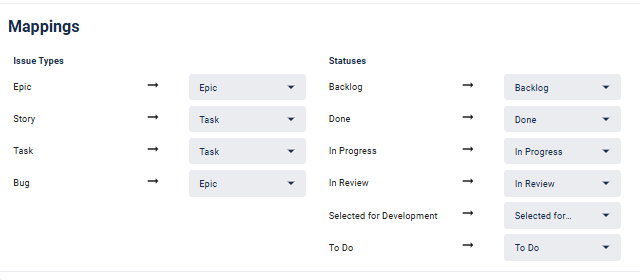
Bulk-move a triage queue or a label cohort. Field mappings are configurable and reusable - the second time the same kind of move happens, it's a single-click action.
Automated routing rules
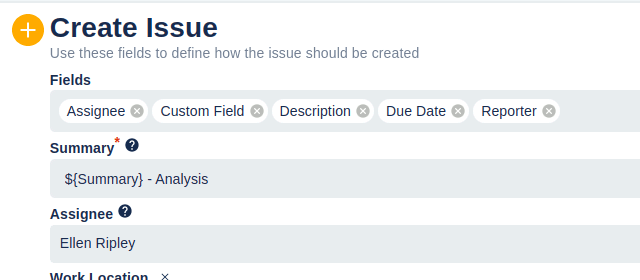
Define rules like 'when label "escalate-engineering" is applied, move to engineering project.' Support managers can configure rules without admin intervention.
Context preservation
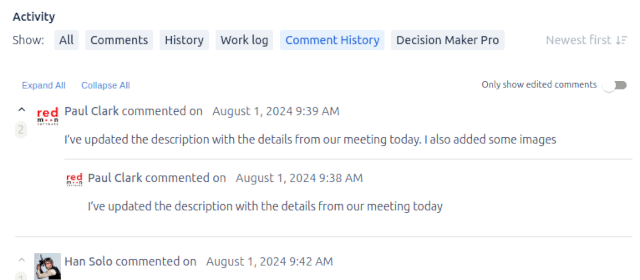
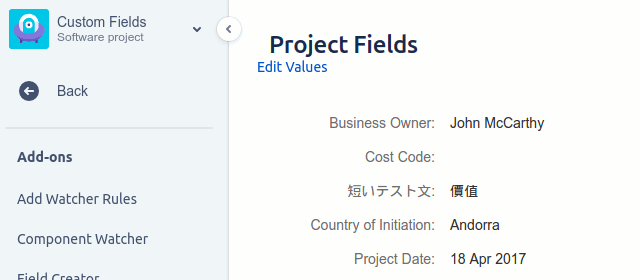
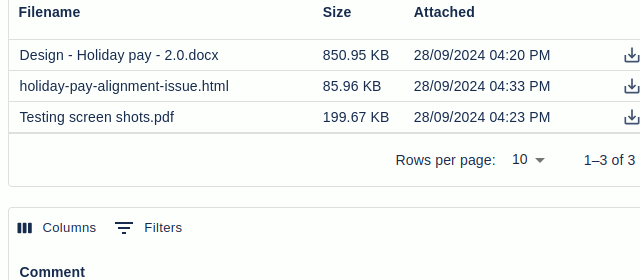
Comments, attachments, watchers, links, and custom fields travel with the issue. Engineering picks up the ticket with the full customer context intact.
Audit trail of moves
Every move is recorded with source project, destination, user, and time - so 'which team has this ticket now' is always answerable.
Use cases
- Escalation on a P1 customer incident. Support tags a P1 incident with 'escalate-engineering.' Move It's rule auto-moves the ticket to the engineering project with full context, watchers and attachments preserved.
- Bulk triage split. Sunday-morning triage produces 40 tickets that need to move from the catch-all queue to specific product engineering projects. Move It's bulk action handles them in two minutes.
- Security-incident routing. Support spots a security-shaped ticket in the customer-facing queue. One-click move to the security project; the customer context, including attachments, comes along.
- Product-feedback routing. Support routes feature-request tickets to the product project automatically when the 'feedback' label is added - so PMs always have the unfiltered customer voice.
Common questions from support teams
Why isn't native Jira's move feature enough for support?
Native Jira's move is a multi-screen wizard that costs minutes per ticket and loses field context across project schemas. For a support team moving tens or hundreds of tickets per week from service-desk to engineering, that overhead is significant. Move It collapses the manual move to a single action and supports rule-based automation - so routing scales with ticket volume.
Can support managers set their own routing rules?
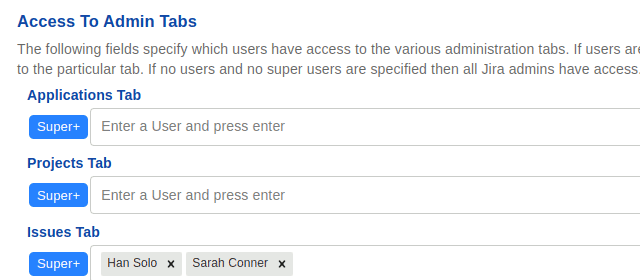
Yes. Move It's rule configuration is accessible to project admins, not just site admins. Support managers can define rules like 'move on label,' 'move on customer-impact field,' or 'move on priority threshold' without filing an admin ticket. Rules are project-scoped, so configuration changes don't affect unrelated workflows.
Do comments and attachments survive the move?
Yes - that's central to the product. Comments, attachments, watchers, links, sub-tasks, and custom fields all travel with the issue. Engineering opens the moved ticket with the full customer context intact, which is the difference between a useful escalation and a back-and-forth re-explanation.
Will Move It work with Jira Service Management?
Yes. Move It handles moves between Jira Service Management projects and standard Jira software projects - which is the most common support-to-engineering routing pattern. The request-type and issue-type are mapped per move rule, so a JSM 'incident' becomes an engineering 'bug' (or whatever your schema requires) with the customer context preserved.
Try Move It for your team
Move It works for support teams on Jira Cloud and Data Center. Install from the Atlassian Marketplace, or read the main Move It page for the full feature list.
Try Move It on the Atlassian Marketplace ↗ See the full Move It overview →
Also built for
Move It solves a different problem for each team: