









Why this matters for legal teams handling disputes and holds
Litigation hold is, in effect, a promise to a court that the company will preserve relevant records. Native Jira makes that promise hard to keep on its comment surface. Edits overwrite. Deletions erase. Custodian discipline - ‘do not edit or delete’ - is the only line of defense, and even compliant custodians can lose records accidentally.
For legal teams, the consequence is spoliation risk. The dispute proceeds, discovery arrives, and the comment trail that should support the company’s position has gaps that the company cannot explain. Spoliation findings - or even the suggestion of one - have outsized consequences in litigation. Native Jira leaves legal exposed precisely because the preservation surface is mutable.
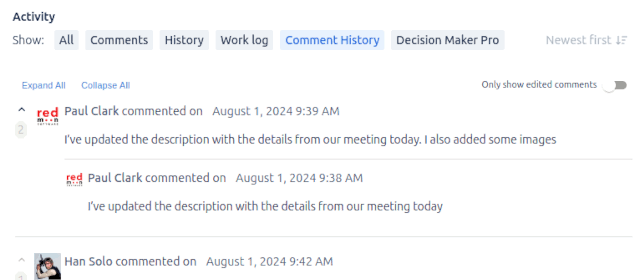
Comment History reduces that exposure. The comment trail is preserved at the platform level, not the custodian level. Edits create new versions, not overwrites. Deleted comments stay in the Comment History store. Visibility changes are attributed. The duty to preserve is honored by configuration rather than by custodian discipline - which is the only reliable model in practice.
Where this fits in the legal workflow
- Hold issuance - Comment History is the platform control that backs the hold notice. Custodians can be told to preserve; the platform makes preservation actual.
- Discovery production - per-ticket exports produce the versioned, attributed comment trail in a form suitable for production. Discovery responses go out in hours.
- Spoliation analysis - if questions arise about destruction of evidence, Comment History shows every edit and deletion with attribution - so analysis is data-driven.
What “good” looks like
Good is the litigation hold where the trail of comments on every in-scope ticket is preserved through every edit and deletion, and discovery responses drop into the e-discovery workflow with provenance intact. Comment History exists so legal teams can honor preservation duties on Jira without depending on custodian discipline.
What legal teams (disputes and litigation hold) are dealing with today
- Litigation hold requires preservation of relevant records - native Jira's comment-edit model overwrites the record, undermining preservation duties.
- Discovery requests for the comment trail on disputed tickets find that edits and deletions have erased the contemporaneous record.
- Spoliation risk arises when relevant comments are silently edited or deleted during a hold - native Jira gives legal no tools to prevent or detect this.
- Hold notices issued to custodians don't prevent edit-overwrite behavior in Jira - so even compliant custodians can lose evidence accidentally.
- Disputes turning on 'what did the team say in writing' often hinge on comment-thread reconstruction, which native Jira makes impossible.
- Outside counsel asking for the comment history on a sample of hold-relevant tickets cannot be answered from native Jira.
How Comment History helps legal teams (disputes and litigation hold)
Preservation through edits and deletions
Comment History captures every comment version at creation and edit. Deleted comments remain in the Comment History store. Preservation continues through accidental or deliberate user behavior.
Litigation-hold export
Per-ticket or per-JQL exports produce the full versioned, attributed comment trail as PDF or CSV - dropping directly into hold collection or discovery response.
Spoliation-risk reduction
Because the trail is preserved independently of user behavior, even silent edits or deletions during a hold do not erase the evidence. Spoliation risk drops sharply.
Custodian-friendly preservation
Custodians under hold continue to use Jira normally. Preservation happens at the platform level, not the custodian-discipline level - which is the only reliable model for hold compliance.
Attributed visibility changes
Visibility-scope changes on hold-relevant comments are recorded with attribution - so the question 'who changed who could see this comment' is answerable in a discovery context.
Use cases
- Active litigation-hold preservation. Litigation hold is issued covering a project. Comment History continues to capture every comment version on tickets in scope, ensuring preservation even if users edit or delete during the hold.
- Discovery response on disputed tickets. Discovery request asks for the comment trail on a defined set of tickets. Comment History exports the immutable, versioned, attributed trail per ticket in hours, not weeks.
- Spoliation analysis. Counsel needs to evaluate whether evidence was destroyed during the dispute. Comment History shows every edit and deletion on the relevant tickets, with attribution and timestamps.
- Disputes turning on written record. Internal dispute over what was agreed in writing on a ticket. Comment History shows the original comment, every edit, and the final version - resolving the dispute on data rather than memory.
Common questions from legal teams (disputes and litigation hold)
Does Comment History support litigation-hold compliance?
Yes - and this is one of its strongest legal use cases. Litigation hold requires preservation of relevant records. Native Jira's comment-edit model overwrites those records on every edit, which undermines preservation regardless of custodian discipline. Comment History preserves every version automatically, so the duty to preserve is honored at the platform level - which is the only reliable model in practice.
What about spoliation risk during a hold?
Spoliation arises when relevant evidence is destroyed - intentionally or accidentally - during litigation or while preservation duties apply. Native Jira's edit-overwrite and silent-delete behaviors create substantial spoliation risk during holds. Comment History eliminates most of that risk because the trail is preserved independently of user behavior. Even an accidental edit during a hold does not destroy the original.
Can we produce discoverable exports from Comment History?
Yes. Per-ticket and per-JQL exports produce the versioned, attributed comment trail as PDF or CSV, with timestamps and authors. The export format is suitable for discovery production and for outside-counsel review. Many legal teams pair the export with their wider e-discovery workflow - Comment History supplies the Jira-side evidence, the e-discovery platform handles the rest.
Will this work for both Jira Cloud and Data Center holds?
Yes. Both Marketplace listings - Cloud and Data Center - preserve the comment trail with the same versioning, attribution, and export capabilities. Cloud storage runs on Atlassian's Cloud infrastructure; Data Center stores in the Jira database. Legal teams running mixed environments can apply the same preservation model across them, simplifying hold consistency.
Try Comment History for your team
Comment History works for legal teams (disputes and litigation hold) on Jira Cloud and Data Center. Install from the Atlassian Marketplace, or read the main Comment History page for the full feature list.
Try Comment History on the Atlassian Marketplace ↗ See the full Comment History overview →
Also built for
Comment History solves a different problem for each team:
- Comment History for Audit Teams
- Comment History for Banking Teams
- Comment History for Compliance Teams
- Comment History for Healthcare Teams
- Comment History for Jira Admins
- Comment History for Legal Teams
- Comment History for Regulated Industries
- Comment History for Security Teams
- Comment History for Support Teams