








Why this matters for support teams
Support comments are different from engineering comments. They have customer impact every time someone hits post - the words in that comment are what the customer reads, hears about, and remembers. An edit isn’t a quiet rewrite; it’s a retraction, and retractions can be quoted in escalations.
Three behaviors show up in support workflows that native Jira can’t track:
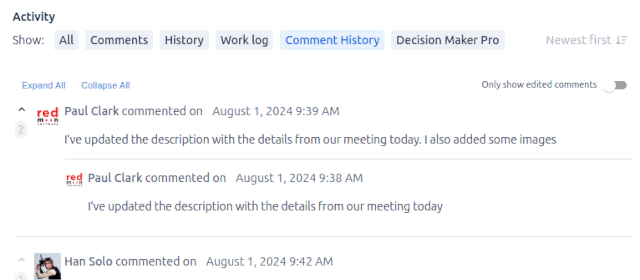
- Agent drafts - new agents often write a reply, post it, then re-edit several times. Native Jira shows only the final draft. Comment History shows the trajectory.
- Visibility flips - a comment intended for the internal team gets posted with All Users visibility, then quickly switched back. The customer may have seen it briefly. Comment History records both the original visibility and the switch, with attribution.
- Defensive deletions - a heated reply gets deleted before management notices. Comment History preserves it.
None of these are common, but they’re the cases that cost the most when they happen. Most support teams install Comment History as cheap insurance against the rare, expensive failure modes.
What it doesn’t change
Comment History doesn’t change how customers see the conversation, doesn’t slow down the comment editor, and doesn’t add fields to the Create or Reply screens. It runs entirely behind the scenes and only surfaces when someone with the right permissions opens the History view on a comment. The end-customer experience is unchanged.
What support teams are dealing with today
- Internal triage notes get edited or deleted mid-investigation, and there's no record of what was originally said.
- Customer-facing comments get rewritten ('I meant to say...') and the original wording is lost.
- A comment posted with the wrong visibility (internal-only intended, All Users selected) can be retracted but not un-seen - and there's no record of who switched it.
- Support QA reviews second-guess the customer reply but have no way to see earlier drafts.
- Complaint escalations to management need 'the full record' and the team can only show the current state.
How Comment History helps support teams
Every version of every reply
Comment versions are captured at the moment of post and every edit. Support managers can see the actual chain of what was sent and what was retracted.
Visibility-change audit
When a comment's visibility scope is switched - particularly the dangerous All Users -> internal-only flip - the change is logged with author and timestamp.
Deleted-comment review
Comments deleted by agents (intentionally or accidentally) remain in Comment History. Restore them or just include them in the QA review.
Search across deleted content
Find the right ticket by searching comment content, including content that's since been deleted. Useful when re-investigating a recurring customer complaint.
Use cases
- Support QA. Review a random sample of resolved tickets per week. Comment History surfaces edited and deleted comments so the QA reviewer sees the full conversation, not just the polished final version.
- Escalation defense. Customer claims an agent said something offensive in a deleted comment. Comment History either confirms the claim and supports a coaching conversation, or refutes it with the original text.
- Agent coaching. New agents often re-edit replies multiple times. The edit history shows the drafting process and identifies patterns to coach on.
- Cross-team escalation reconstruction. When a ticket bounces support -> engineering -> support, the comment chain can grow messy. Comment History keeps the originals intact, so the reviewer can see what each handoff actually said.
Common questions from support teams
What happens when an agent edits a customer-facing comment?
Native Jira overwrites the comment - the customer's notification carries the original text, but the issue itself shows only the edited version. Comment History keeps both: the customer-notified version and every subsequent edit. The original is searchable and exportable.
Can Comment History reveal who edited a comment?
Yes - every version is attributed to the user who made it, with timestamp. This is particularly useful for tickets that pass through many hands: support agents, supervisors, engineering, customer success. Comment History shows exactly who touched what.
Does Comment History work with Jira Service Management?
Yes - Comment History tracks comments on any Jira issue, including JSM customer requests. The internal/visibility tracking is especially valuable in JSM because of the customer-facing nature of the comments.
How does this differ from Jira's built-in issue history?
Jira's built-in history tracks field changes (Status, Assignee, Priority) but does not track comment edits or deletions. The History tab on a Jira issue shows that a comment was 'updated' or 'deleted,' but not the previous content. Comment History fills the gap.
Can support managers limit who sees the comment history?
Yes. Comment History respects Jira's permission model - history visibility can be restricted to project administrators, support managers, or any other role. End-users don't see the version chain by default; reviewers do.
Try Comment History for your team
Comment History works for support teams on Jira Cloud and Data Center. Install from the Atlassian Marketplace, or read the main Comment History page for the full feature list.
Try Comment History on the Atlassian Marketplace ↗ See the full Comment History overview →
Also built for
Comment History solves a different problem for each team:
- Comment History for Audit Teams
- Comment History for Banking Teams
- Comment History for Compliance Teams
- Comment History for Healthcare Teams
- Comment History for Jira Admins
- Comment History for Legal Teams
- Comment History for Legal Teams (Disputes and Litigation Hold)
- Comment History for Regulated Industries
- Comment History for Security Teams