








Why this matters for legal teams
Discovery in software companies increasingly includes Jira tickets. Engineering decisions, change-management approvals, customer-support escalations, and incident postmortems all live there. When litigation, regulatory investigation, or internal review reaches into that data, the legal team needs to produce the record that actually existed - not just the version currently visible.
Native Jira makes that hard. Comments are mutable by design: edits overwrite, deletions are final, and visibility changes leave no audit log. The discovery answer “we couldn’t produce it because Jira doesn’t keep it” is technically true but rarely defensible.
Comment History changes the underlying data model so the answer changes too. Once installed, comment activity becomes an append-only log. That log is what production, hold, and review actually need.
The strongest argument for installing preventatively
Comment History captures going forward, not backward. A company that installs the app after a litigation hold is issued has missed the window for everything that was edited or deleted before installation. The companies that get the most value install it as part of their default Jira configuration - alongside backups, permission schemes, and audit logging - so that whenever a hold arrives, the data it needs is already there.
What legal teams are dealing with today
- E-discovery requests touch Jira and find no comment audit trail to preserve.
- Litigation hold can't actually hold what was already deleted before hold was issued, and native Jira deletes are irreversible.
- Contract dispute requires reconstructing what was agreed in a comment chain that's since been edited.
- Outside counsel asks for 'all comments on this issue' and the team has no defensible way to produce them.
- Regulatory investigation arrives weeks after the relevant comments were posted; some have been edited or removed.
How Comment History helps legal teams
Immutable comment versions
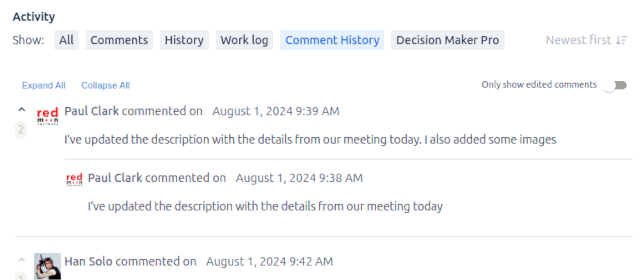
Every version of every comment is captured at the moment it's created or edited. The historic record survives subsequent edits, deletions, and visibility changes.
Defensible export
Generate a full export of comment history for an issue, a project, or a JQL-defined set of issues. The export includes author, timestamp, version chain, and visibility scope for each entry.
Deleted-comment retention
Comments deleted from Jira remain in Comment History with the original author and timestamp. Restore them to the issue or just include them in the export for counsel.
Per-comment chain of custody
Every version records who made the change, when, and from what version. The chain is what defensible production looks like.
Visibility-change tracking
If a comment was reclassified from internal-only to All Users (or vice versa), the change is recorded - including who did it. Useful in privilege disputes.
Use cases
- E-discovery production. Plaintiff requests every comment on tickets matching a JQL filter. Export the full comment history including deleted versions in a single CSV/PDF set with timestamps and authors.
- Litigation hold. Hold notice covers a project. Comment History prevents the silent loss of evidence: even if someone deletes a comment after the hold, the previous version is preserved.
- Privilege review. Reviewer needs to know which comments were originally posted with internal-only visibility. Comment History shows the initial visibility and any subsequent changes.
- Regulatory response. Regulator asks for the decision-making record on a customer ticket from six months ago. Produce the comment chain as it existed at any chosen date, with every intervening edit visible.
Common questions from legal teams
Is Comment History defensible in legal proceedings?
Comment History preserves a chronological, immutable record of comment activity with author attribution and timestamps - the elements typically required for a business-records exception. Defensibility ultimately depends on jurisdiction and case posture, but the underlying data Comment History captures is structured for production. Many regulated firms use it specifically because native Jira's deletion model is hard to defend.
Can Comment History capture comments that were deleted before installation?
No. Comment History captures comments going forward from installation. Anything deleted from native Jira before Comment History was installed is irrecoverable. This is the strongest argument for installing it preventatively rather than reactively - litigation hold can't preserve what's already been overwritten.
How does Comment History interact with Jira's retention policies?
Jira's native retention deletes issues (and their comments) per the configured policy. Comment History's storage is separate and can be configured with an independent retention window - typically longer than Jira's, to meet legal-hold and regulatory minimums. Talk to compliance about the right retention floor for your jurisdiction.
Can users tell Comment History is installed?
There's no covert mode - Comment History adds a 'History' link or panel to each comment in the Jira UI. This is intentional: users should know that comment edits are tracked, the same way the issue itself shows an audit log. The transparency is a feature, not a bug.
Does Comment History work for Cloud and Data Center?
Yes. Two listings on the Marketplace, same functional surface. Comment History for Jira Data Center stores history in the Jira database alongside other Jira data. Comment History for Jira Cloud uses Atlassian's Cloud infrastructure. Both produce equivalent exports.
Try Comment History for your team
Comment History works for legal teams on Jira Cloud and Data Center. Install from the Atlassian Marketplace, or read the main Comment History page for the full feature list.
Try Comment History on the Atlassian Marketplace ↗ See the full Comment History overview →
Also built for
Comment History solves a different problem for each team:
- Comment History for Audit Teams
- Comment History for Banking Teams
- Comment History for Compliance Teams
- Comment History for Healthcare Teams
- Comment History for Jira Admins
- Comment History for Legal Teams (Disputes and Litigation Hold)
- Comment History for Regulated Industries
- Comment History for Security Teams
- Comment History for Support Teams