









Why this matters for product managers
Product managers are the source of ticket shape in most teams. The epic’s strategic context, the story’s acceptance criteria, the spike’s hypothesis, the discovery’s success metric - all of it has to come from somewhere, and the PM is usually it. Native Jira’s single static description per issue type is not enough to capture the shape, so PMs end up maintaining wiki templates and hand-copying them on each new ticket.
That hand-copy step is where the consistency dies. Some tickets carry the field shape; others don’t. Some have the sub-task list; others don’t. Some have the strategic context; others don’t. Dashboards and reports try to draw on data that’s only partly present. Cross-functional handoffs find that the design or security sub-tasks weren’t created. New PMs rebuild the shapes from scratch and the team drifts.
STM Issue Templates makes the shape a property of the system. The PM picks the template; the ticket arrives complete. Quarterly planning, daily epic-creation, and cross-functional handoffs all benefit from the same consistency. The PM writes content, not structure.
Where this fits in the PM workflow
- Quarterly planning - epic templates produce consistently-shaped epics by the dozen, all reportable on the same dashboards.
- Story creation - story templates pre-create design, accessibility, security, and analytics sub-tasks - so nothing cross-functional gets forgotten.
- Discovery and spikes - spike templates produce written decisions, not just closed tickets, by scaffolding hypothesis, methodology, and decision sections.
What “good” looks like
Good is the PM whose quarterly plan ends with thirty epics, all in the same shape, all reportable on the same dashboards, all carrying the cross-functional sub-tasks the team will need. STM Issue Templates exists so PMs can spend their time on content instead of on rebuilding scaffolds.
What product managers are dealing with today
- Native Jira's per-issue-type description is a single static block - PMs end up copy-pasting epic and story templates from a wiki page every time.
- Discovery, spike, and design tickets each need different scaffolds - context, hypothesis, success criteria, decision log - and the team forgets the structure on every new ticket.
- Recurring sub-tasks on a story (design review, accessibility check, security review) get forgotten when the story is created from a blank issue.
- Cross-functional handoffs (PM to design, PM to engineering) fail when the ticket arrives in a different shape than the receiving team expects.
- New PMs join the team and rebuild the ticket shapes from scratch - or worse, don't, and the team's ticket quality drifts.
- Quarterly planning produces dozens of epics - none of them in the same shape unless PMs hand-copy from a template they're maintaining manually.
How STM Issue Templates helps product managers
Templates for epics, stories, spikes, discovery
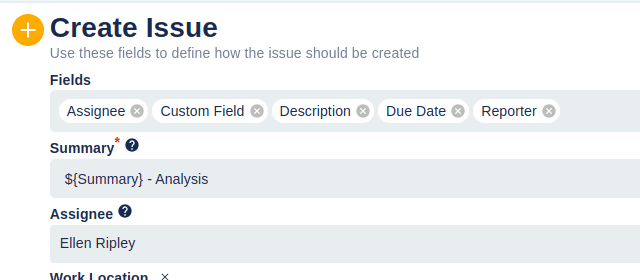
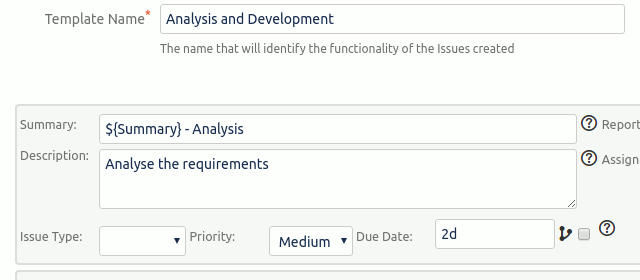
Define a template per work-type. Epic templates carry the strategic-context scaffold; story templates carry acceptance-criteria scaffold; spike templates carry hypothesis-and-decision scaffold.
Pre-populated sub-tasks
Templates create the standard cross-functional sub-tasks - design review, accessibility check, security review, copy review - automatically. PMs stop having to remember them.
Field-shape consistency
Templates enforce the field shape across all stories in a workstream - priority, customer segment, success metric, target release - so reports and dashboards have real data to draw on.
PM-grade description scaffolds
Markdown-rich description scaffolds with headings - context, hypothesis, success criteria, open questions - so PMs fill in content instead of structure.
Quarterly planning acceleration
Templates make epic creation a single action. Quarterly planning produces dozens of consistently-shaped epics instead of hand-copied variants.
Use cases
- Epic template for strategic initiatives. Strategic-epic template carries the context, customer-problem, hypothesis, success-metric, and stakeholder-list scaffold - and creates the standard 'design,' 'security review,' and 'launch comms' sub-tasks.
- Story template with cross-functional sub-tasks. Story template includes the acceptance-criteria scaffold and pre-creates design-review, accessibility-check, and analytics-instrumentation sub-tasks.
- Discovery / spike template. Discovery template carries hypothesis, methodology, time-box, and decision-log sections - so spikes produce a written decision, not just a closed ticket.
- Launch checklist template. Launch-ticket template creates the standard pre-launch sub-tasks - go-no-go review, comms approval, support readiness, analytics check - so no launch goes out missing one.
Common questions from product managers
How is this better than copying a description from a wiki page?
Wiki templates lose the field shape, the sub-tasks, the components, and the labels. PMs who copy from a wiki end up filling in description but skipping the fields the dashboards need - and reinventing the sub-task list every time. STM templates produce a complete, shape-consistent ticket in one action, with description, fields, sub-tasks, and components all in place.
Can we have different templates for different products or teams?
Yes. Templates are defined per-project. A growth team's epic template can differ from a platform team's epic template; both differ from a discovery team's spike template. PMs pick the right template at creation; everything else is pre-populated. New team members learn the templates rather than the field schema.
Do template sub-tasks behave like normal sub-tasks?
Yes. Sub-tasks created from a template are standard Jira sub-tasks with the project's workflow, transitions, and SLA rules. They appear in dashboards and JQL exactly like manually-created sub-tasks. Automation rules, reports, and integrations apply to them without changes.
Will this help during quarterly planning?
Yes. Quarterly planning produces a burst of epic and story creation, and consistency matters most under burst load. With STM, PMs select the right template and the epic arrives with the strategic scaffold, fields, and cross-functional sub-tasks in place. The plan ends with consistently-shaped epics that dashboards can actually report on - instead of hand-copied variants that drift.
Try STM Issue Templates for your team
STM Issue Templates works for product managers on Jira Cloud and Data Center. Install from the Atlassian Marketplace, or read the main STM Issue Templates page for the full feature list.
Try STM Issue Templates on the Atlassian Marketplace ↗ See the full STM Issue Templates overview →
Also built for
STM Issue Templates solves a different problem for each team: