








Why this matters for QA teams
QA runs on shape. A test cycle has a structure - smoke sub-tasks, regression coverage, exploratory notes, release-readiness checks. A bug report has a structure - reproduction steps, environment, expected, actual, severity, browser. A regression suite has a structure - per-area coverage, per-area pass/fail. Without consistent shape, QA can’t produce comparable results across releases, and engineering can’t triage bug reports quickly.
Native Jira doesn’t enforce that shape. Issue types are containers; the structure inside each ticket is built by QA from memory and convention. As a result, test cycles drift in coverage, bug reports drift in completeness, and release-readiness dashboards pull data that isn’t really there.
STM Issue Templates makes the shape a system feature. The QA tester picks a template; the ticket arrives with the structure attached - sub-tasks for the cycle, fields for the bug, scaffold for the test case. Coverage stays consistent. Bug-report quality rises. Release-readiness dashboards report on real data because the data exists on every ticket.
Where this fits in the QA workflow
- Test cycles - templates per cycle type create consistent coverage; releases are comparable across cycles.
- Bug reporting - the bug-report template scaffolds reproduction, environment, and severity - so engineering gets triage-ready tickets.
- Regression suites - regression templates pre-populate the standard coverage list; surfaces that should be tested every release are tested every release.
What “good” looks like
Good is the QA tester who files a bug from exploratory testing in two minutes, with reproduction steps, environment, browser, and severity all in the fields the engineer expects - because the template put them there. STM Issue Templates exists so QA teams can run consistent cycles and ship triage-ready bugs without rebuilding the shape on every ticket.
What qa teams are dealing with today
- Test cycles created from scratch in Jira lose consistency - some have the smoke-test sub-tasks, others don't.
- Bug reports arrive missing reproduction steps, environment, and expected-vs-actual - QA has to chase data before triage.
- Regression-suite tickets fail to cover the standard surface because the sub-task list is rebuilt by memory each release.
- Cross-team handoffs to engineering fail when bug tickets lack the structured fields engineering depends on.
- New QA team members learn the team's shape conventions slowly - or not at all - because nothing systematic enforces them.
- Release-readiness dashboards pull garbage data because test-cycle fields aren't populated consistently.
How STM Issue Templates helps qa teams
Test-cycle templates
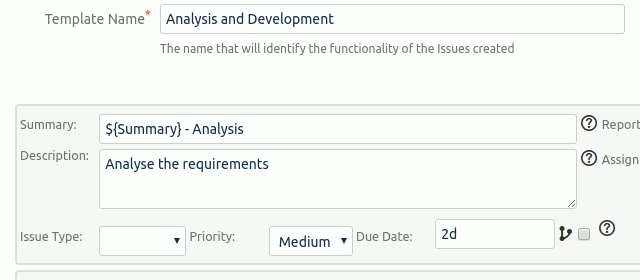
Define a template per test cycle (release smoke, regression, beta, exploratory) that pre-creates the standard test-execution sub-tasks - so cycles always cover the right surface.
Bug-report templates
Standardized bug-report template with reproduction-steps, environment, expected/actual, severity, and screenshot scaffolding - so engineering gets actionable bug tickets, not vague ones.
Regression-suite scaffolding
Regression-suite templates pre-populate the sub-task list for the regression surface - login, checkout, payment, search - so coverage stays consistent across releases.
Field-shape enforcement
Test cycles and bug tickets carry consistent fields - release, environment, severity, browser - so release-readiness dashboards report on real data.
Cross-team handoff readiness
Bug tickets handed to engineering arrive in the shape engineering expects, with reproduction steps and environment data already in the fields - reducing back-and-forth on triage.
Use cases
- Release smoke-test cycle. Smoke-test template creates the standard 'login,' 'critical-path,' 'checkout,' 'payment' sub-tasks with the release-version field pre-populated. Smoke coverage is consistent release-over-release.
- Bug-report from exploratory testing. Bug-report template scaffolds reproduction-steps, expected/actual, environment, browser, and severity - so the engineer triaging the bug has the data they need without back-and-forth.
- Regression suite for major release. Major-release regression template pre-creates the full surface-coverage sub-task list - one sub-task per regression area. Coverage stays consistent across major releases.
- Beta-cycle telemetry capture. Beta-cycle template includes telemetry-capture, customer-feedback-summary, and known-issues sub-tasks. Beta cycles produce comparable output across releases.
Common questions from qa teams
Doesn't Jira already have issue types for test cases?
Jira has issue types, but issue types are containers, not templates. A 'test case' issue type doesn't pre-populate the test-step structure, the environment fields, the reproduction scaffold, or the sub-task list. STM templates layer on top of issue types - so 'create a test case' becomes 'create a test case with the team's standard scaffold' in one action.
Can templates handle different test cycles?
Yes. Smoke, regression, beta, and exploratory cycles each have different shapes - different sub-task lists, different field requirements, different scaffolds. Define a template per cycle type; QA picks the right template at cycle start; the cycle is created with the right structure. Cycles become comparable across releases because their shape is consistent.
Will this work alongside Xray or Zephyr?
Yes. STM operates at the Jira issue level and doesn't conflict with test-management apps that operate at the test-case-execution level. Teams using Xray or Zephyr for execution often use STM for the surrounding test-cycle, bug-report, and regression-suite shape - because STM addresses the ticket-creation surface those apps don't focus on.
Does this help with bug-report quality?
Yes - this is typically the biggest QA win. Bug reports that arrive missing reproduction steps, environment data, or severity are the largest source of triage friction between QA and engineering. The STM bug-report template scaffolds all of it, so the QA tester fills in content instead of structure. Engineering gets a triage-ready ticket; back-and-forth drops; resolution times drop.
Try STM Issue Templates for your team
STM Issue Templates works for qa teams on Jira Cloud and Data Center. Install from the Atlassian Marketplace, or read the main STM Issue Templates page for the full feature list.
Try STM Issue Templates on the Atlassian Marketplace ↗ See the full STM Issue Templates overview →
Also built for
STM Issue Templates solves a different problem for each team: