








Why this matters for support teams
Support teams run on consistency. Every incident type has a standard shape - the fields that matter, the sub-tasks that always need doing, the components and labels that drive routing and reporting. Native Jira gives you a default description and nothing else; the rest of the shape has to come from agents remembering it on every ticket.
For a busy support team, that memory requirement is the single biggest source of triage quality issues. Missing severity. Missing environment. No ‘capture browser logs’ sub-task on a performance ticket. No ‘notify security’ sub-task on a suspicious-activity ticket. Reviewers find the gaps after the fact; agents reinvent the shape on the next incident.
STM Issue Templates makes the shape a system feature. The agent picks the template; the ticket arrives with fields populated, sub-tasks created, components attached, and description scaffold in place. Quality issues drop. New-agent onboarding accelerates. Cross-team handoffs go smoothly because the receiving team gets the shape they expect.
Where this fits in the support workflow
- Intake - templates per incident type pre-populate the right field shape. Triage starts from a complete ticket.
- Standard response - templates create the standard sub-tasks. The diagnostic and comms plan is attached automatically.
- Handoff - tickets handed off to engineering, security, or product arrive in the standard shape the downstream team expects.
What “good” looks like
Good is the new agent who can take an outage ticket on day three because the template carries the structural knowledge - severity field, comms sub-task, root-cause sub-task, impacted-services component all in place. STM Issue Templates exists so support teams can scale triage quality without scaling training overhead.
What support teams are dealing with today
- Inbound support tickets arrive with inconsistent fields - missing customer, environment, severity - forcing triage agents to chase data before they can work.
- Recurring incident types (login failure, performance issue, outage) get re-described from scratch every time, without standard sub-tasks attached.
- Multi-step incident-response sub-tasks (alert customer, capture logs, escalate engineering) get forgotten because they're not pre-populated.
- New support agents reinvent the triage shape for each incident type, slowing onboarding and producing inconsistent results.
- Quality reviews of support tickets find missing fields and missing sub-tasks repeatedly - because nothing systematic pre-populates them.
- Cross-team handoffs (support to engineering, support to security) fail because the receiving team gets a partial ticket instead of a standard shape.
How STM Issue Templates helps support teams
Reusable incident templates
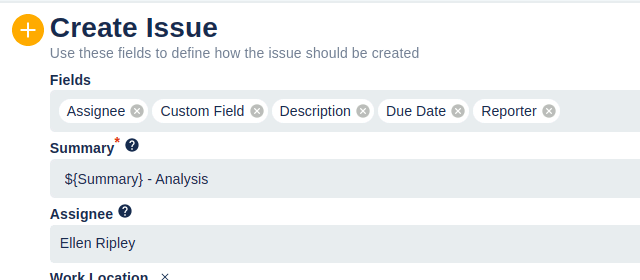
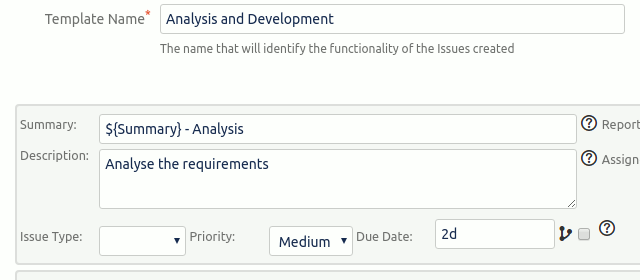
Define templates for each common incident type. New tickets created from the template arrive pre-populated with fields, components, sub-tasks, and standard description content.
Sub-task automation
Templates create the standard incident-response sub-tasks - alert customer, capture logs, escalate engineering - automatically. Nothing gets forgotten.
Field-shape standardization
Templates enforce a standard field shape - customer, environment, severity, impact - so every ticket of the same type carries the same data.
Faster agent onboarding
New agents learn the templates rather than the field schema. Day-one productivity rises because the system carries the structural knowledge.
Cross-team handoff readiness
Tickets handed off to engineering or security arrive in the standard shape those teams expect - reducing back-and-forth and accelerating resolution.
Use cases
- Outage incident template. Major-outage template pre-populates severity, impacted-services, comms-required sub-task, root-cause sub-task, and standard description scaffolding. Triage starts with a complete shape.
- Performance complaint template. Performance template pre-creates the 'capture browser logs,' 'capture network HAR,' and 'reproduce in staging' sub-tasks - so the agent has the diagnostic plan attached from the start.
- Security-shaped incident template. Suspicious-activity template pre-creates 'preserve evidence,' 'notify security,' and 'block account' sub-tasks - and tags the ticket for security-team routing.
- New-customer onboarding ticket. Customer-onboarding template includes the standard provisioning sub-tasks - account, training, dashboard, success-check-in - so onboarding always covers the same scope.
Common questions from support teams
Why aren't Jira's native templates enough for support?
Native Jira lets you set a default description on an issue type, but doesn't pre-populate fields, doesn't create sub-tasks, doesn't attach components, and doesn't handle multiple templates per issue type. Support teams need different shapes for outage vs. performance vs. security incidents - and the only way to produce them in native Jira is by training agents to remember. STM Issue Templates makes the shapes a system control.
Can supportable templates differ per request type?
Yes. Templates are defined per-project and selectable per-issue-type or per-request-type. An outage incident, a performance complaint, and a new-customer onboarding request each get their own template - with their own field shape, sub-task list, and description scaffold. Agents pick the right template at intake; everything else is pre-populated.
Do sub-tasks created by templates respect the project's workflow?
Yes. Sub-tasks created from a template are real Jira sub-tasks with the project's workflow, transitions, and SLA rules. They behave exactly like manually-created sub-tasks - so existing reports, JQL queries, and automation rules apply to them without changes.
Will this help with quality of triage?
Yes - that's typically the main reason support teams adopt it. The two biggest quality issues in triage are 'missing fields' and 'missing sub-tasks,' both of which arise when agents have to remember the standard shape on each ticket. Templates remove the memory requirement: the shape is created with the ticket, so reviewers find the right data on every ticket rather than chasing it after the fact.
Try STM Issue Templates for your team
STM Issue Templates works for support teams on Jira Cloud and Data Center. Install from the Atlassian Marketplace, or read the main STM Issue Templates page for the full feature list.
Try STM Issue Templates on the Atlassian Marketplace ↗ See the full STM Issue Templates overview →
Also built for
STM Issue Templates solves a different problem for each team: