








Why this matters for support teams
Support runs on signal. The P1 just landed. The VIP customer’s ticket is in the queue. The SLA is 30 minutes from breach. The duty manager needs to see this. The off-shift on-call needs to see that. Native Jira’s notification scheme makes all of those signals look identical to the routine status updates that fill the same inboxes - which is the same as having no signal at all.
For a support team running a busy queue, the consequence is missed escalations, late SLA recoveries, VIP customers waiting longer than they should, and agents either drowning in notifications or tuning them out entirely. The fix is not ‘more notifications’ - it’s targeted, rule-based ones.
Watch It supplies the targeted layer. Rules trigger on the events that matter - P1 arrival, VIP ticket creation, approaching SLA, escalation - and route alerts to the people who need to act. The routine update noise stays in the queue view where it belongs. The high-signal alerts cut through because they are no longer competing with low-signal ones.
Where this fits in the support workflow
- Real-time triage - P1 and VIP rules alert duty manager and account manager when high-attention tickets land. The wider team sees the queue; the duty manager sees the alert.
- SLA management - approaching-breach alerts give the assigned agent and team lead enough warning to recover before SLA reporting takes a hit.
- Out-of-hours coverage - time-window rules route after-hours alerts to on-call and pager surfaces, separate from in-hours notification paths.
What “good” looks like
Good is the duty manager whose Watch It alerts are short, targeted, and almost always actionable - because the routine queue noise is filtered out and only the events that need attention come through. Watch It exists so support teams can keep signal high without the team tuning out notifications entirely.
What support teams are dealing with today
- Jira's default notification scheme floods everyone watching a ticket with every comment, status change, and field update - producing inbox noise that gets ignored.
- Support managers can't easily set 'alert me on every P1 in my queue' or 'alert on SLA breach' without complex automation rules.
- Tier-2 escalation alerts get missed because the escalation signal doesn't differentiate from routine updates in the notification stream.
- VIP customer tickets need elevated attention but Jira can't natively route 'this customer's ticket' to specific people.
- Out-of-hours coverage notifications can't be easily targeted - so off-shift agents either get everything or get nothing.
- Notification scheme changes in native Jira require admin involvement and affect every user - making team-specific tuning impractical.
How Watch It helps support teams
Rule-based custom notifications
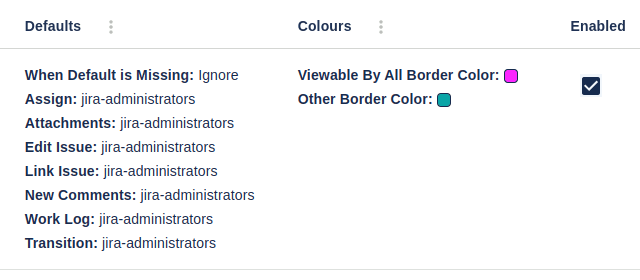
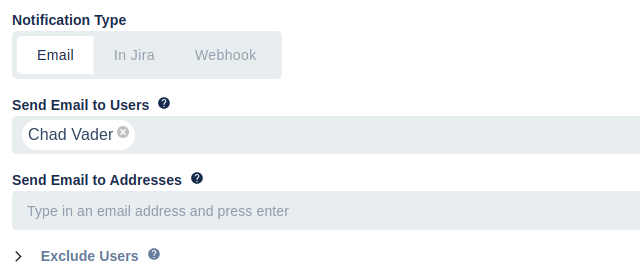
Define rules like 'when priority = P1 in queue X, alert agent Y' or 'when customer = VIP, alert account manager.' Rules are project-scoped and managed by the support team, not by site admins.
SLA-breach alerts
Watch It triggers targeted alerts on approaching or breached SLAs - to the responsible agent and their manager - without spamming the wider team.
VIP customer routing
Tickets from VIP customers automatically notify the account manager and the senior agent on shift - separate from routine ticket notifications.
Out-of-hours coverage rules
Time-window-aware rules route after-hours P1s to the on-call agent and the duty manager, instead of broadcasting to the whole team.
Reduced notification noise
By targeting alerts at the people and events that matter, Watch It reduces the volume of low-signal notifications - which makes the high-signal ones actually get noticed.
Use cases
- P1 escalation alert to duty manager. Watch It rule alerts the duty manager whenever a P1 ticket lands in the support queue. The whole team sees the ticket in the queue; only the duty manager gets a direct notification.
- VIP customer ticket routing. Ticket from a VIP customer triggers an alert to the account manager and the senior agent on shift. Routine tickets from non-VIP customers don't generate the same alert.
- Out-of-hours P1 routing. P1 tickets arriving outside business hours notify the on-call agent's phone and the duty manager's pager. Daytime P1s use a different notification path.
- Approaching-SLA-breach alert. Ticket within 30 minutes of SLA breach generates a targeted alert to the assigned agent and their team lead - so escalation happens before breach, not after.
Common questions from support teams
Why is Jira's default notification scheme a problem for support?
Native Jira sends every ticket update to every watcher - the assignee, the reporter, anyone watching the project, and everyone CC'd. The signal-to-noise ratio collapses fast on a busy support queue, and important alerts get lost in the noise. Watch It adds rule-based notifications targeted at specific events and people, so the alerts that actually require action stand out from the routine updates.
Can support managers configure their own rules?
Yes. Watch It's rules are project-scoped and accessible to project admins - not just site admins. Support managers can define rules for their queue without filing an admin ticket. Rules can be created, modified, and disabled at team speed, which is essential for the kind of tuning that support coverage requires.
How does Watch It handle SLA-breach alerts?
Watch It can trigger on the same SLA signals Jira Service Management surfaces - approaching breach, breached, escalated. Rules can target the assigned agent, their team lead, the duty manager, or any combination. Most teams set a soft alert at 30 or 60 minutes before breach, and a louder alert on breach itself - so the team has time to recover before SLA reporting takes the hit.
Will Watch It replace Jira's native notification scheme?
Watch It works alongside Jira's native notifications, not as a replacement. Native notifications continue to handle their baseline role (assignee, reporter, watchers); Watch It adds the targeted, rule-based layer on top. Most support teams reduce the native notification surface gradually as Watch It rules pick up the high-signal alerts - the two coexist.
Try Watch It for your team
Watch It works for support teams on Jira Cloud and Data Center. Install from the Atlassian Marketplace, or read the main Watch It page for the full feature list.
Try Watch It on the Atlassian Marketplace ↗ See the full Watch It overview →
Also built for
Watch It solves a different problem for each team: