








Atlassian Team ’26: Why the Future Belongs to AI-Native Organizations
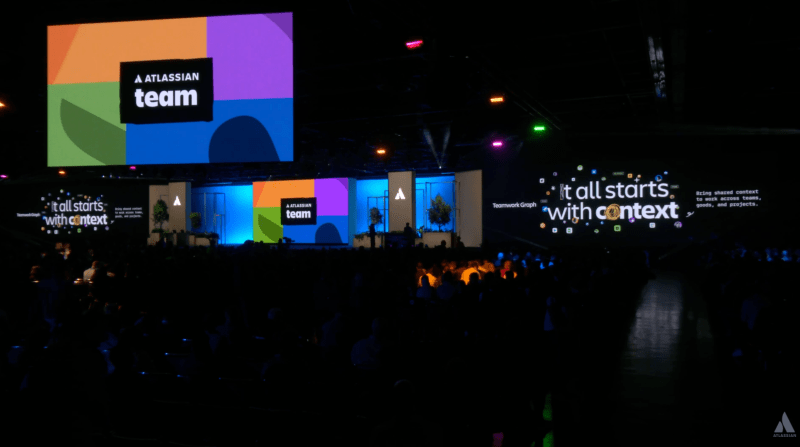
Atlassian Team ’26 was more than a technology conference or a showcase of new software features. It was a statement about how work itself is changing in the age of artificial intelligence. During the keynote, Atlassian CEO and co-founder Mike Cannon-Brookes described what he called the rise of the “AI-native organization,” a new type of company where AI is not simply an assistant layered on top of existing workflows, but a core part of how teams operate every day. According to Atlassian, businesses are entering a period where humans and AI agents will collaborate continuously, with humans focusing on strategy, decision-making, and creativity while AI handles execution at scale. The company positioned this transformation as one of the most significant shifts in modern work, comparing it to a complete rearchitecture of organizational operations rather than just another wave of productivity software.
One of the central ideas repeated throughout the keynote was that artificial intelligence itself is no longer the competitive advantage it once was. Mike Cannon-Brookes emphasized that powerful AI models are becoming widely accessible and affordable, meaning that intelligence can effectively be purchased “by the token.” In this environment, companies cannot differentiate themselves simply by adopting AI tools because every organization has access to similar capabilities. Instead, Atlassian argued that the true differentiator is context. Context includes institutional memory, project histories, workflows, customer relationships, meeting notes, team knowledge, and all the information accumulated inside a business over time. This internal knowledge becomes the foundation that allows AI systems to provide meaningful insights and take useful actions. According to Atlassian’s vision, the organizations that best organize and connect their knowledge will become the most effective AI-native companies.
A major focus of the presentation was Atlassian’s “Teamwork Graph,” which the company described as a system capable of connecting data and knowledge across enterprise platforms such as Confluence, Salesforce, and other workplace applications. The keynote demonstrated how AI agents could use this interconnected information to generate dashboards, summarize meetings, organize planning sessions, and provide live operational intelligence in real time. One demo showed an AI-generated dashboard built from more than twenty years of customer relationship data pulled dynamically from multiple systems. Instead of manually compiling reports or analyzing spreadsheets, the AI assistant generated visual insights instantly. The message behind these demonstrations was clear: the future workplace will rely less on manual coordination and more on AI systems capable of synthesizing information automatically.
Another example focused on a company planning off-site where teams had produced large amounts of documentation, spreadsheets, and decisions over several days. Traditionally, summarizing and organizing all of this information would require hours of communication, document review, and coordination between employees. In the demo, an AI agent created a Confluence whiteboard summarizing the entire planning session within moments. Atlassian presented this as an example of reducing the “coordination tax” that slows many organizations down. Instead of employees spending time searching for information, messaging coworkers, or switching between applications, AI agents can gather and structure knowledge immediately. This is especially valuable for new employees or cross-functional teams that often struggle to understand the context behind decisions and projects.
The keynote also highlighted how AI-native systems are designed to support both business users and technical teams. For marketers, designers, executives, and product managers, the AI tools focused on summarization, planning, collaboration, and organizational visibility. One demonstration showed how AI could bridge the gap between business goals and existing technical systems during a design system migration. The user asked where the organization wanted to go and what currently existed, and the AI analyzed both the strategic requirements and the underlying technical assets to connect those two worlds together. Atlassian framed this as a way to reduce friction between planning and execution, allowing teams to move faster while maintaining alignment across departments.
For technical teams and developers, Atlassian introduced a command-line interface connected to the Teamwork Graph. By typing “TWG” into a terminal, developers could access organizational context directly from the command line. This demo suggested a future where AI agents become integrated into engineering workflows and infrastructure management rather than existing as separate chatbot windows. The CLI experience emphasized that AI tools are increasingly being designed for agents first, enabling automated systems to retrieve information, execute workflows, and support developers directly inside their working environments. Atlassian’s broader vision appeared to center on embedding AI deeply into the tools people already use instead of forcing teams to adapt to entirely new platforms.
Another important theme from the keynote was governance. Atlassian acknowledged that as AI agents become more autonomous and gain access to enterprise systems, organizations will need strong oversight mechanisms. The presentation briefly introduced the concept of “agent governance,” referring to permissions, auditing, security controls, and accountability for AI systems operating across company data and workflows. This reflects a growing recognition across the industry that enterprise AI adoption is not only a technical challenge but also an operational and organizational one. Companies will need ways to monitor what AI agents are doing, ensure they follow company policies, and maintain trust as automation expands into more critical business functions.
Ultimately, the message of Team ’26 was not simply about improving productivity. Atlassian presented a vision of work where AI systems become active participants inside organizations, helping teams coordinate, execute, and make decisions faster than ever before. The keynote repeatedly warned against a “wait and see” mindset, arguing that businesses moving too slowly risk falling behind during a major technological transition. Whether or not every prediction becomes reality, the event made one thing clear: Atlassian believes the future belongs to organizations that successfully combine human judgment with AI-driven execution powered by rich organizational context. In this vision of the future, the companies that win will not necessarily be those with the smartest models, but those with the best understanding of their own knowledge, workflows, and teams.